Reuben’s Home Inspection Blog
Home Inspections in the Twin Cities-
Electric Baseboard Heaters – The Flipper Favorite
Posted on March 9th, 2010 No commentsWhen I inspect a home in Minneapolis or Saint Paul that has electric baseboard heat, it’s usually a dead giveaway that someone did some remodeling, or someone flipped the house. In fact, the only houses that I run across in the Twin Cities metro area with all electric baseboard heaters are houses that have been ‘flipped’. Why? I’ll get there.
The times when electric baseboard heaters make the most sense to install are when someone wants to add heat to a room that won’t be used frequently, and they don’t need air conditioning. One common place for Minneapolis and Saint Paul houses would be basement bedrooms that get added as guest bedrooms. Another would be additions that just don’t stay as warm as they should. I added a couple baseboard heaters to a sun room at my own house that doesn’t get very good air flow from the furnace, and I turn the heaters on when the temperature drops below zero outside.
The nice thing about electric baseboard heaters is that they’re easy to install, they don’t cost much, and there isn’t a lot that can go wrong with them. The only failure I’ve found during home inspections is that the thermostats have gone bad, and this isn’t a difficult fix. Most of the problems that I write up during home inspections deal with improper installations. I’ve listed the two most common offenders below.
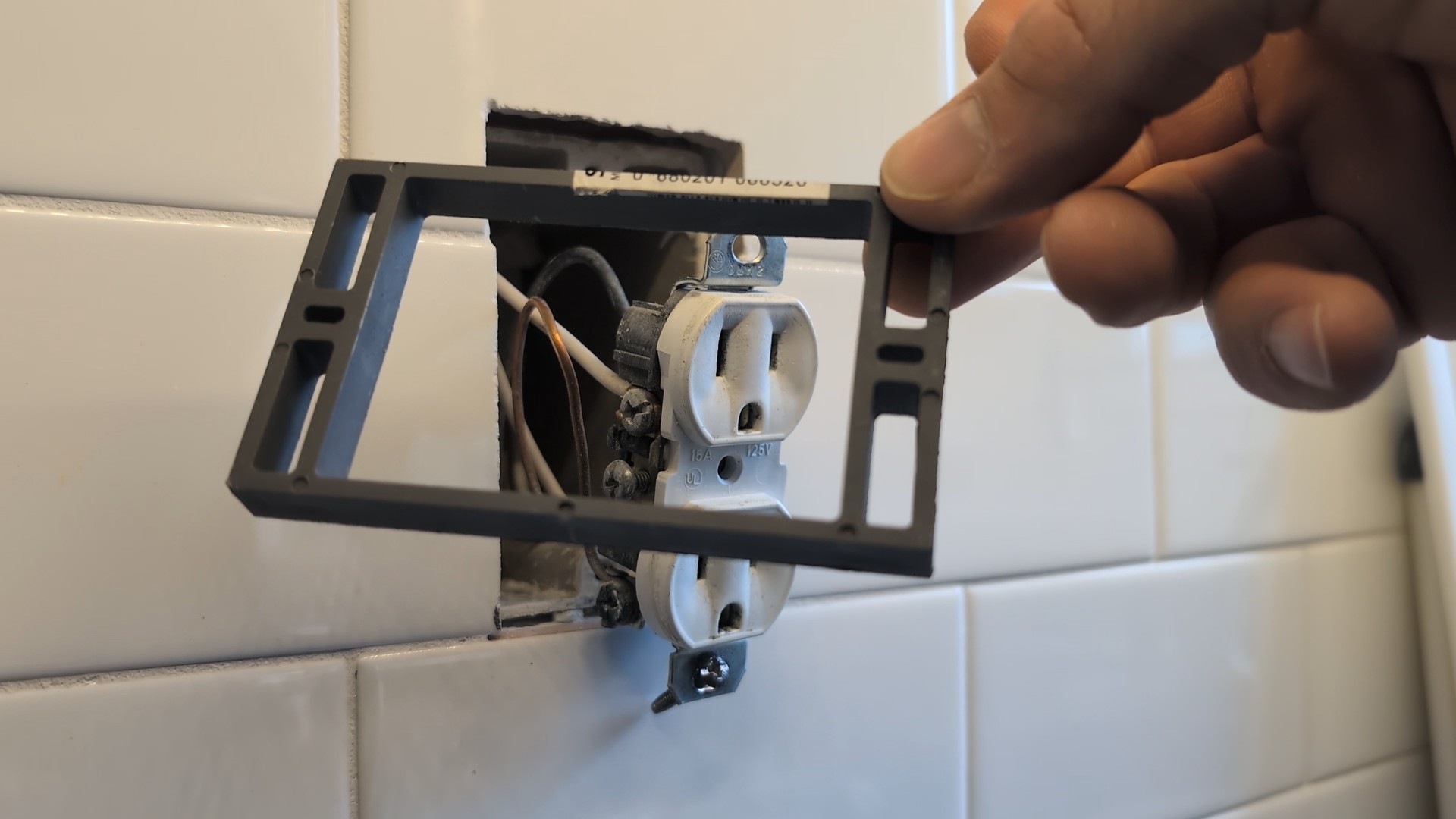
Outlets Installed Above The Heater All manufacturers of electric baseboard heaters prohibit the installation of electrical outlets above the heaters. Electric baseboard heaters work by turning a heating element on and off; it’s either hot or it’s not, nothing in-between. Because they get so hot, an electric wire draped in front of a baseboard heater could potential melt or start a fire.
Improper Clearances Electric baseboard heaters require certain clearances above and in front of the units to anything combustible, such as drapes. Again, the reason for this is to prevent a potential fire. The clearance requirements vary – just check out the two diagrams below from two different manufacturers. One says twelve inches, the other says six.
These clearance requirements shouldn’t be taken lightly. The photo below came from a recent inspection where the drapes looked like they were about to burst in to flames.
So why are baseboard heaters a favorite of the fix-n-flipper? They’re cheap and easy to install. On the downside, electric baseboard heaters cost far more to operate than a gas fired furnace… but why would the person flipping the house care? They won’t be paying the heating bills. For homes in rural areas where power companies offer off-peak discount rates for electricity, electric baseboard heaters might make sense as the primary source of heat, but not here in the heart of the Twin Cities.
Reuben Saltzman, Structure Tech Home Inspections - Email - Home Inspector Twin Cities
-
How Serious Is A Cracked Heat Exchanger?
Posted on March 2nd, 2010 No commentsIt’s an industry standard: if a furnace has a cracked heat exchanger, it gets replaced. The American Gas Association has even put this in writing – they say “Any visible crack or hole is reason for requiring replacement of the heat exchanger or furnace.” When I inspect a furnace and I find a cracked heat exchanger (and I find a lot of them), I always say to replace it.
So what’s the big deal with cracks or holes? The concern is that a cracked heat exchanger could allow exhaust gas from the furnace to contaminate the household air with carbon monoxide. In order for this to happen, the furnace must be producing high levels of carbon monoxide AND the exhaust gas must be mixing with the household air. For a good example of a hazardous heat exchanger, check out the photo below showing a large rust hole in the heat exchanger of this high-efficiency furnace that was only ten years old.
Cracks, on the other hand, I’m not so sure about. With the majority of the cracked heat exchangers that I’ve seen, I’ve always been curious how the exhaust gas from the furnace could possibly leak out of those tiny cracks enough to contaminate the househouse air. Of course, what I’m curious about doesn’t matter… but sometimes my curiosity gets the best of me, and I have to find out for myself.
So I did. I took home a furnace that had a cracked heat exchanger, and I removed the heat exchanger cell that had the largest cracks. You can see the cracks for yourself below – click on any of the photos for a larger version. This first photo shows the cracks as seen from inside the heat exchanger cell – this is what we saw during our inspection.
These next two photos show the cracks from the exterior, or blower side of the heat exchanger cell. This part of the heat exchanger is usually not visible during the course of a home inspection.
I wanted to see if water would leak through these cracks, so I doused the outside of the heat exchanger and looked inside for any signs of leakage. Nothing.
I’ve heard that penetrating oil, such as WD40, will get through the cracks, so I tried that next. Nothing.
Feeling pretty disappointed at this point and determined to get some results, I filled the heat exchanger with water. I laughed like a mad scientist at what happened next.
Water began to leak out of the factory seam in about ten different places, but the crack never leaked.
Why does this tiny crack mean the furnace should be replaced? I’ve heard that when heat exchangers get very hot, the metal expands and the cracks open up, allowing air to leak in to or out of the heat exchanger. Just because my test didn’t allow any water to leak doesn’t mean that this furnace was safe, and it doesn’t mean that a different furnace will behave the same way… but I sure found it amusing.
Maybe I need to get out more.
RELATED POSTS:
- Furnace Certifications Might Be Useless
- Does A Better Inspection Increase Liability?
- Houses Don’t Need CO2 Detectors
Reuben Saltzman, Structure Tech Home Inspections - Email - Twin Cities Home Inspector
-
Drive-By Inspections
Posted on February 23rd, 2010 2 comments“Deal with it now or deal with it later.” That’s a phrase I’ve heard my father, Neil Saltzman, say many times.
Here in the Twin Cities, there are two primary types of inspections that are done on houses: Buyers Inspections, which are extremely thorough inspections performed for a buyer, and Truth In Sale of Housing (TISH) evaluations, which are quick inspections required for the seller in fourteen of the larger cities in the metro area. Here at Structure Tech, we do both.
When we perform TISH evaluations, we’re required to follow the guidelines published by the city that we’re inspecting in. The guidelines are actually quite detailed books that state exactly how the TISH evaluations should be performed, and how different conditions on a home should be rated. For example, here is an excerpt from the Exterior Foundation section in the Minneapolis TISH Guidelines:
76) Foundation
A) The evaluator shall determine if all visible components of the foundation are in a professional state of repair. Missing or damaged mortar, broken, loose or missing block or bricks shall be marked as B. Damaged or loose plaster/stucco on the foundation, or exposed foam insulation shall be marked as B. The evaluator shall also check the foundation walls conditions such as leaning, cracks, and buckling or bulging conditions, which may indicate structural failure. If these conditions exist, mark as SC.
One might think with all that detail, evaluations would be somewhat uniform between evaluators, right?
They’re not.
Just as there are some home inspectors that will knowingly downplay problems with a house in order to not ‘kill a deal’, and thereby continue to receive referrals from a real estate agent, there are several TISH evaluators that do the same thing on TISH evaluations. We call them ‘drive-by inspections.’
It’s one of the dirty secrets in my industry.
These evaluators receive referrals for doing a poor job. Maybe it’s ignorance, maybe it’s incompetence, some say laziness, and it might even be dishonesty. Whatever the reason, it’s always the same small group of people that produce reports that completely ignore blatent problems. These inspectors continue to stay in business because they charge less money and there is actually a market for drive-by inspections.
How could there be a market for drive-by inspections? Some think that a cleaner inspection report will make a house more marketable. I suppose that if you compared two identical houses, the house with the ‘clean’ report would be more attractive than the house with the thorough report… but that’s not the end of the story.
Almost every buyer will hire a private inspector, and most home inspectors will uncover defects with the home. What happens now? As I mentioned in my blog Does The Seller Need To Fix This?, buyers will often ask sellers to make repairs, take money off the purchase price, or cancel the purchase. Now the seller is stuck having to make hasty decisions on problems that could have been avoided had they hired a thorough inspector.
If a house has problems, the problems will need to be dealt with. If you want to deal with problems at the last minute, go with the cheapest inspector and get a drive-by inspection. If you prefer to deal with problems ahead of time, hire a thorough TISH Evaluator, or even better yet, have the TISH evaluator perform a Seller’s Inspection at the same time. In other words, deal with it now or deal with it later.
Reuben Saltzman, Structure Tech Home Inspections - Email - Minneapolis TISH Evaluator
-
Who Inspected Your Roof?
Posted on February 16th, 2010 2 commentsLast week I mentioned that municipal inspectors will sometimes miss important details on permit inspections, partially because they just don’t have the time to go over every little detail on a home the way that a private inspector does. That reminded me of another aspect of municipal inspections in the Twin Cities that most people don’t know about:
Municipal inspectors typically don’t walk on roofs to inspect them.
That’s right. When municipal inspectors in the Twin Cities come out to inspect roofs, they will rarely set foot on the roof, or even lean a ladder up against the roof. The rules vary between cities – some prohibit their inspectors from walking roofs, while others actually provide ladders for their inspectors.
So why don’t municipal inspectors walk on roofs? Because they don’t have to. It’s documented in the Minnesota Administrative Rules for Inspections (1300.0210, Subp. 4.):
“The person requesting an inspection required by the code shall provide access to and means for inspection of the work.”
This means that if you expect your municipal inspector to walk on your roof, or even use a ladder to inspect it, you better have a ladder leaning up against your roof when they show up. They probably won’t be bringing their own ladder. If you DO have a ladder… they still might not.
Roofing contractors all tell me the same thing; municipal roof inspections are anything but thorough. One roofer told me that city inspectors barely get out of their vehicles. I have a high degree of respect for municipal inspectors and I had a hard time believing my roofer friends. To find out for myself, I sent out emails to twenty of the largest municipalities in Minnesota, asking if their building inspectors will walk roofs. I wrote:
“If a municipal inspector is coming out to inspect a permit for a residential roof replacement, will they walk on the roof to inspect it if a ladder is provided? The roof has a pitch of 4:12, and is free of snow, ice, water, debris, etc.”
FYI – A 4:12 roof is a very low-sloped roof (see photo above).
Here are the responses I received:
- No response – 4
- No. Inspectors are not allow to walk on sloped roofs, period – 4
- Maybe? Vague answers to my direct question – 4
- Yes. As long as all of the requirements listed above are met – 7
- Yes, we rock. Department policy requires inspectors to walk on roofs with a slope of 6:12 or less, and the inspector’s vehicles are equipped with ladders for doing so – 1 (Saint Louis Park).
Go Saint Louis Park. Their municipal inspections department continues to impress me.
Here are two more tips I picked up from the email responses that I received:
- Some municipalities allow / require digital photos of the roof underlayment in lieu of an initial inspection. The City of Blaine (among others) has a document detailing how to send in digital photos to the building inspections department. Click here to see it – scroll to the bottom of the document.
- None of the municipalities will approve permits when the roofs are covered with snow. Homeowners are supposed to call for inspections in the spring, after the snow has melted. Municipalities end up with “hundreds and hundreds and hundreds” of roofing permits that never get closed out.
If you have your roof replaced, make sure someone leaves a ladder for the inspector. At least this way you’ll have a chance of someone getting on your roof to inspect it.
Reuben Saltzman, Structure Tech Home Inspections - Email - Twin Cities Home Inspector
RELATED POST:
- No response – 4
-
“…But The City Approved It!”
Posted on February 9th, 2010 3 commentsIt happens to me several times each year; I inspect a home for a buyer, I point out a construction defect, then I get a call from an angry seller or seller’s agent, accusing me of being wrong.
If someone challenges my call, I’m always happy to provide an authoritative reference to prove that I’m not just throwing my opinion around. I can give code references to prove my calls if I’m challenged. This is why it’s important for home inspectors to know building codes, even though they’re not doing code inspections… but I digress.
The crazy argument that I sometimes get from home sellers and seller’s agents is that a defect that I reported on is not a problem, because the defect wasn’t identified as a part of the permit inspection process. The argument sounds like this:
Angry Home Seller: ”That hole in my roof is fine! You had no right to tell the person buying my house that it’s wrong.”
Me: “That hole is not acceptable. It will leak water in to the house.”
Indignant Home Seller: ”That roof was just installed a month ago, and the installation meets the requirements for the Minneapolis Building Code.”
Me: ”What makes you say that?”
Misinformed Home Seller: “The City of Minneapolis approved the permit. That means it meets the city’s code.”
While a hole in the roof is an extreme example, the logic applied by this home seller is just as flawed when it comes to other less extreme defects, such as improper nails in joist hangers, improper furnace venting, attic bypasses on new construction… you name it.
Municipal inspectors often have very full schedules and don’t have the luxury of taking their sweet time during inspections like I do. If a municipal inspector misses a violation of the code, it doesn’t mean that the violation was approved.
To prove my point, I’ll even give you a code reference from the Minnesota State Building Code (insert smiley winky face).
Subpart 1. General. Construction or work for which a permit is required is subject to inspection by the building official and the construction or work shall remain accessible and exposed for inspection purposes until approved. Approval as a result of an inspection is not approval of a violation of the code or of other ordinances of the jurisdiction. Inspections presuming to give authority to violate or cancel the provisions of the code or of other ordinances of the jurisdiction are not valid. It shall be the duty of the permit applicant to cause the work to remain accessible and exposed for inspection purposes. Neither the building official nor the jurisdiction is liable for expense entailed in the removal or replacement of any material required to allow inspection.
Good times.
Reuben Saltzman, Structure Tech Home Inspections - Email - Twin Cities Home Inspector
-
Joist Hanger Installation Defects
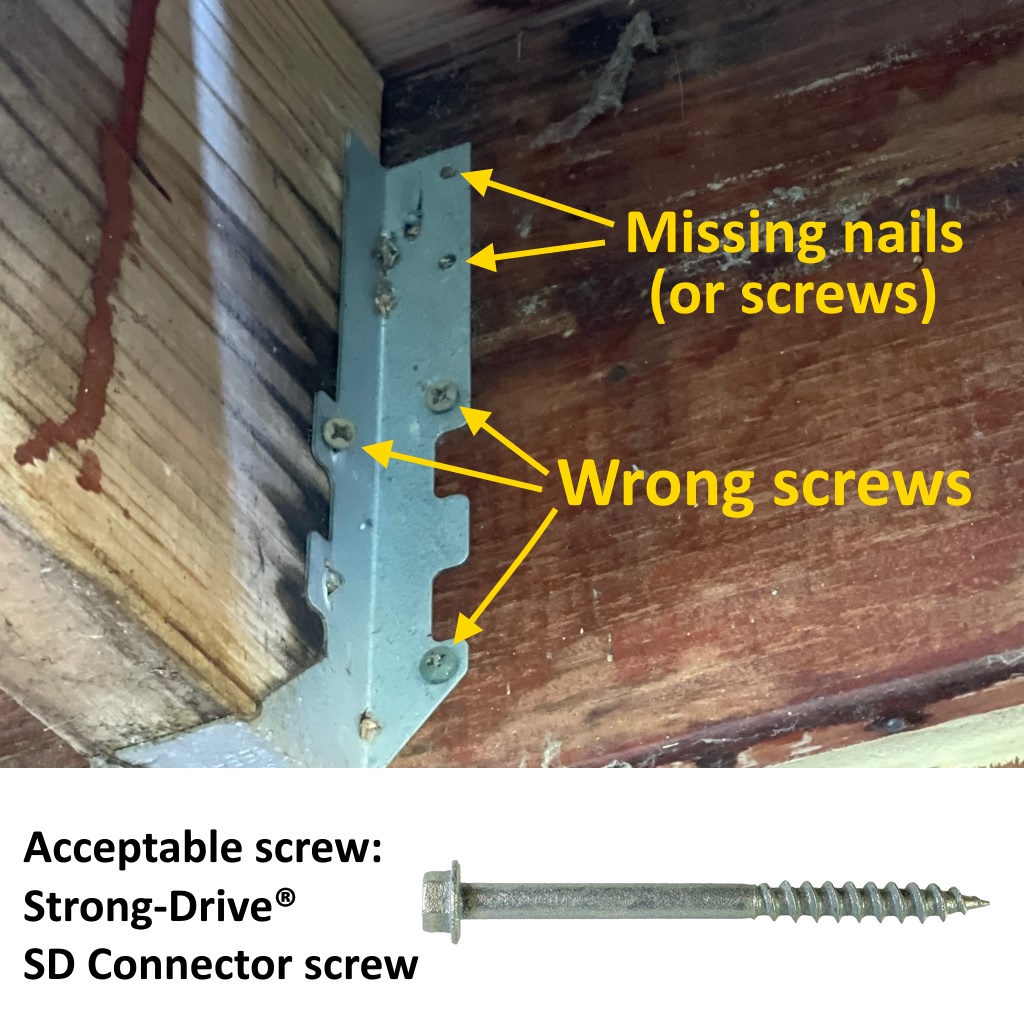
Posted on February 2nd, 2010 4 commentsJust a little over a year ago, I took a class put on by one of the largest manufacturers of metal brackets, Simpson Strong-Tie. That class was a real eye opener – I realized afterwards that just about every deck that I inspect is constructed wrong. Not all of the installation defects are major, but they’re always worth pointing out. Today I’ll talk about one of the most common installation defects that I find with joist hangers in the Twin Cities – improper nails.
You thought I was going to say missing nails, didn’t you? Too easy, too obvious.
Wrong Nails If the wrong nails are used at a joist hanger, it won’t perform as intended. To know what nails are supposed to be used, you first need to know what joist hanger you’re working with. The most common joist hanger I find on decks is a LUS28*. This joist hanger can be used with 2×8 and 2×10 joists. Now that I know which hanger I’m using, I can go to the Simpson Strong-Tie web site to find out what fasteners are specified. To see the full page I’m looking at, click here.
As you can see, this hanger requires 6-10d nails + 4-10d nails. The big defect that I often find is that 10d x 1 1/2″ nails are used in place of 10d nails. If you look down on the far right column of the above chart, you’ll notice only a few hangers will allow a 10d x 1 1/2 nail. So what’s the difference between the two? Quite a bit! The photo below shows the two next to each other.
Now here’s what the nails would look like if driven in to the floor joist. You can see that the smaller nail isn’t long enough to even begin to penetrate the ledgerboard. Click the photo for a blowup.
The really crazy thing about this is that the nails that are so much smaller are actually called “Joist Hanger Nails”! They’re called joist hanger nails because that’s about the only thing they’re good for… but they’re usually not even good for that. If you go to Home Depot and you look at their joist hanger display, you’ll probably find boxes of joist hanger nails sitting with the rest of the joist hangers, and no other types of nails. I’m pretty sure that’s why these nails get used improperly so often.
To identify these “Joist Hanger Nails”, all I need to do is look at the head of the nail. They all have a big “10″ stamped on them. Standard 10d nails don’t have this.
How serious of a problem is this? The manufacturer will allow these nails in to the header, but the total load will need to be reduced to 64% – a huge reduction. The manufacturer does not allow these nails in to the joist. I sent the manufacturer two separate emails to find out what the reduction factor would be if they were used in the joist, but after ten days, no reply.
I meant to make today’s blog about all of the different defects that I find with joist hangers, but this one defect just ended up being enough for a full blog. More on joist hanger defects later.
* Joist hangers meant to be used outdoors or in contact with treated lumber will often have “Z” at the end of the model number. In my example, the joist hanger used for a deck would actually have a model number of LUS28Z.
Reuben Saltzman, Structure Tech Home Inspections - Email - Twin Cities Home Inspector
-
A Missing Jumper Wire At The Water Meter
Posted on January 26th, 2010 3 commentsOne of the most common electrical defects that I find while doing Truth-In-Sale of Housing Evalutions in Minneapolis is a missing jumper wire at the water meter. This is a required repair item, and I often find the repair done improperly, so I’m writing this blog to help anyone that has to fix this item.
To start, here is the wording that TISH Evaluators are supposed to follow, which comes directly from the Minneapolis TISH Evaluator Guidelines (2008):
A) There must always be a jumper wire installed around the water meter. Bonding jumpers shall be of copper or other corrosion-resistant material, have approved clamping devices and be of the correct wire gauge for the service installed. If this jumper wire is not present or is not properly connected on either side of the water meter, (or only the street side, when the water pipes are Pex or similar materials) or is not installed with approved materials, mark as RRE. Be specific on what work is needed
A jumper wire is used to electrically bond the water distribution pipes throughout the house. The purpose of bonding the water distribution piping in the home is to make sure they can’t accidentally become energized. If an ungrounded (aka – hot) conductor came in contact with a properly bonded water pipe, the current would have such a good path back to the main panel that it would overload the circuit breaker and the breaker would quickly trip. In other words, it protects against electric shocks.
A much more important reason that Minneapolis requires a jumper wire at the water meter is that it was once acceptable for the electric service to use the water distribution piping in the house as a grounding conductor. I couldn’t find any great diagrams that showed this type of installation, so I made my own crude diagram. Don’t make fun of my drawing – I know I’m no artist or architect!
And here’s a photo of what this looks like.
The problem with this installation is that if the water piping gets disconnected, the electric panel is no longer grounded to the water piping. That’s why this installation is no longer acceptable. Many old homes in Minneapolis are still wired this way, so it’s especially important for the jumper wire to be present at these houses.
If there is any other break in the water distribution pipes (ie – plastic water piping, plastic water filter, water softener, etc), there needs to be a jumper installed. For a blog specifically talking about this topic, check out Seattle Home Inspector Charles Buell’s blog on jumper wires.
The photos below show what a proper jumper wire should look like. While some TISH evaluators require the bonding clamps to be placed on the outsides of the shutoff valves (vs right next to the meter), I don’t. This might be the preferred method, but that’s all – it’s not a requirement. As always, click the photos for a larger version.
For more information on common Truth In Sale of Housing defects, click on any of the links below.
Reuben Saltzman, Structure Tech Home Inspections - Email - Truth in Housing Evaluator
-
How To Correct Double Tapped Circuit Breakers
Posted on January 19th, 2010 2 commentsDouble tapped circuit breakers are one of the most common electrical defects that I find while doing home inspections in Minneapolis and Saint Paul, and they’re usually one of the easiest defects to correct. Today I’ll explain what double tapping is, when it is and isn’t a problem, why it’s a problem, and how to correct this condition.
I didn’t consult an attorney before writing this article, so I feel like I should add a disclaimer before giving any electrical how-to advice: Don’t do any of this work if you’re not qualified. This is only an overview.
Definition: I don’t know of any official definition of a ‘double tap’. This is just what us home inspectors say when two wires are connected under one screw or terminal inside an electric panel. Sometimes this refers to two wires at one circuit breaker, other times it refers to two wires connected under one screw at the neutral bar. Today I’ll be focusing on improperly double tapped circuit breakers.
When it’s NOT problem: Double tapped wiring is ok if the circuit breaker is designed for two wires. If a circuit breaker is designed for two wires, it will say so right on the circuit breaker, and the terminal of the circuit breaker will be designed to hold two wires in place. The circuit breaker shown below is designed to accept two wires, and I highlighted and blew up the portion of the label that tells me that two wires can be attached. This is acceptable. To my knowledge, the only manufacturers that make circuit breakers that can be double tapped are Square D and Cutler Hammer… but not all of their circuit breakers can be double tapped.
When it IS a problem: This is a problem when the circuit breaker isn’t designed for two wires. The label on the circuit breaker will clearly state this.
Why it’s a problem: If the circuit breaker isn’t designed to hold two wires, the wires could come loose at some point in the future, even if they feel very tight today. Loose wires can lead to overheating, arcing, and possibly a fire.
How to fix: The fixes I’m going to list below are a few common ways of dealing with double tapped circuit breakers.
Pig Tail This is usually the easiest and best repair. The offending wires simply get disconnected from the circuit breaker, connected to a single wire with a wire nut, and that single wire gets connected to the circuit breaker. Now, I know what you’re thinking: “What’s so tough about that?” The answer is nothing. This is a quick and easy fix.
Different Circuit Breaker Another simple repair would be to replace the circuit breaker with a type that is designed for two wires, as long as the panel is designed for it.
If there are more problems going on besides just a double tap, the repair might get more involved. For instance, if a homeowner finished off a basement and added a circuit for the basement bedroom on to the circuit breaker for the bathroom receptacles, simply adding a pig tail for the wires wouldn’t be a proper repair, because the bathroom receptacles can’t be on a shared circuit. In this case, the wires would need to be split off on to two separate circuit breakers. There are a few ways to do this.Add A Circuit Breaker If there is room in the panel, another circuit breaker can be added, and the wires split off to the two different circuit breakers.
Install A Tandem Breaker If the electric panel is designed to use tandem breakers, and a tandem breaker can be properly used in lieu of the offending circuit breaker, this is another acceptable fix. Some people refer to tandem breakers as half-height or half-size breakers. This is basically a way to install two circuit breakers in one slot.
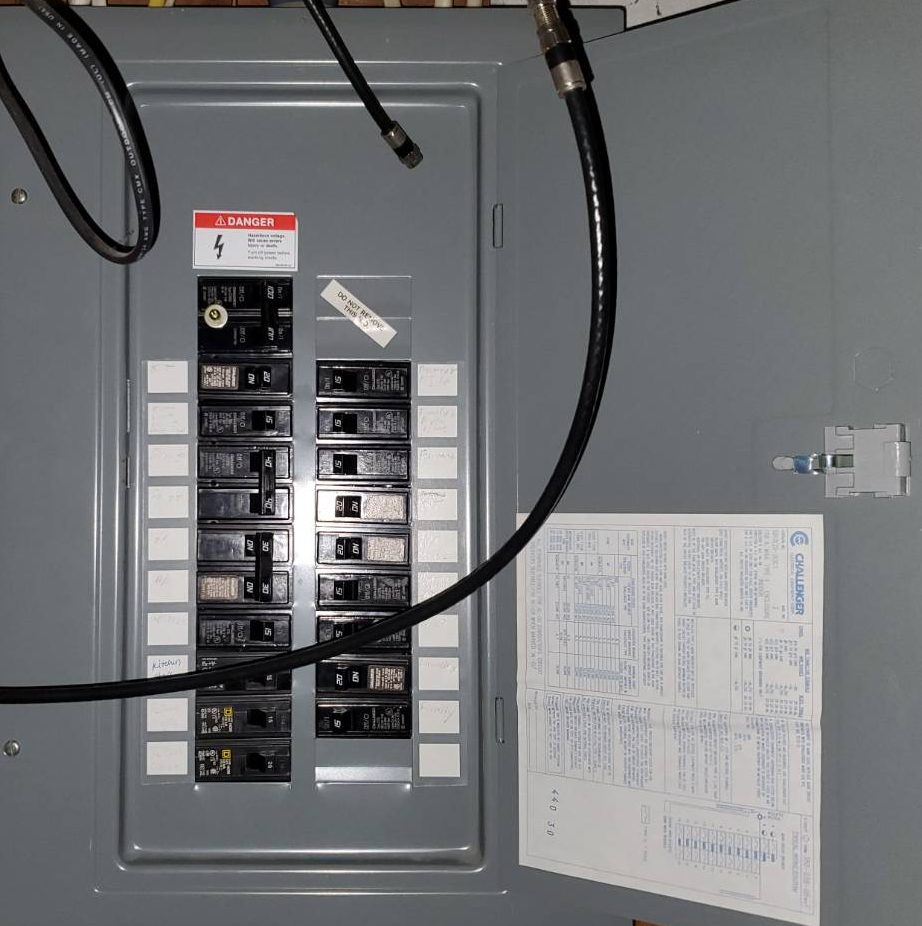
If a panel will accept tandem breakers, it will say so inside the panel, and the specific locations where tandem breakers can be used will be identified. A panel may allow all tandem breakers, notandem breakers, or some tandem breakers. The photo below shows a panel that allows some. As you can see, eight more circuits could be added to this panel, as there are currently no tandem breakers being used.
When none of the above solutions are possible, the repair might involve replacement of the panel with a larger one, or the addition of a subpanel. This would obviously get much more expensive.
Reuben Saltzman, Structure Tech Home Inspections - Email - Minneapolis Home Inspections
-
Are High Efficiency Furnaces Worth The Extra Money?
Posted on January 12th, 2010 4 commentsIn my blog about window replacements, I made it clear that you’ll never get a return on your investment by replacing windows. So what about furnaces? If you’re replacing your furnace, is it worth installing a high efficiency furnace? We’ll see.
I’ve already compiled the data from my gas bills going back to 2004 on my Minneapolis home, so this should be pretty simple to figure out.
- I use an average of 520 therms per year to heat my house.
- The average cost of gas in my area has been $0.90 / therm, making my average annual heating cost $468.
- The average life expectancy of a furnace is about 15 – 20 years.
- My current furnace is 80% efficient, meaning that 80% of the fuel that gets burned is turned in to heat. The other 20% disappears up the vent.
- For this example, I’ll use a 95% efficient furnace, which also qualifies for a tax rebate. This should give me a 15% savings per year, as compared to an 80% efficient furnace.
Saving 15% per year on my heating costs equals out to $70/year. If the furnace only lasted 15 years, I would end up saving $1,050 over the life of the furnace. Because I would qualify for the tax credit, I’d also get 30% back from Uncle Sam.
I’ll assume that the 95% efficient furnace costs about $4000, including installation, but I’ll get 30% back, making the total investment $2800. The 80% efficient furnace would cost about $2000. This means I would end up paying about $800 more for the high efficiency furnace, but I would easily recoup those costs over the life of the furnace.
That seals the deal – my next furnace will be a high efficiency furnace. If my next furnace lasts longer than 15 years or if gas prices go up in the future, I’ll save even more money. The more you spend per year on heating costs, the faster the payback period. Besides saving money, using a high efficiency furnace is a green thing to do.
RELATED POSTS:
- Gravity Furnaces
- Moisture Problems Associated With High Efficiency Furnace Installations
- Furnace Certifications Might Be Useless
- A Frustrating Story About An Improper Furnace Installation
Reuben Saltzman, Structure Tech Home Inspections - Email - Minneapolis Home Inspections
-
One More Ice Dam Removal Method – Blowtorch
Posted on January 6th, 2010 1 commentThis is a follow-up to my blog post on How To Remove Ice Dams. Several people suggested using a blowtorch, and I thought it would be easiest to just follow up with a video. Sorry for the lousy sound quality – I didn’t want to use my good camera on the ladder.
Reuben Saltzman, Structure Tech Home Inspections - Email - Minneapolis Home Inspections
RELATED POST: How To Prevent Ice Dams