Reuben's Home Inspection Blog

Recessed Lights Are Evil

February 1st, 2011 | 47 comments

I love recessed lights, but even the best ones create a ridiculous amount of heat in attics, which can lead to ice dams.  Until I started performing infrared inspections in attics, I never quite grasped how much heat recessed lights contributed to attics, but now my eyes are wide open.  The main problem I find with recessed lights is that they’re not insulated well enough; on a recent home inspection in Maple Grove, I found a home with forty-six recessed lights sticking up in to the attic, along with some wicked ice dams on the roof.

A standard recessed light will stick up in to the attic about seven inches.  If an attic has fourteen inches of  loose fill fiberglass insulation, how much insulation does that leave on top of the recessed light?  Hang on, let me get my calculator…

At any rate, there’s far less insulation above recessed lights than anywhere else in the attic, and these are the areas that get the hottest, so they should really have more insulation than anywhere else in the attic.   Unfortunately, that never happens.  The combination of minimal insulation and hot light fixtures shows up clear as day using an infrared camera.

Recessed Light in attic with IR overlay

The images above show how much heat is leaking through the insulation above an IC rated, airtight recessed light with a 75-watt incandescent bulb.  IC rated means that it’s safe to have insulation directly in contact with the light, but it’s not synonymous with airtight.  You can usually tell if a recessed light is airtight just by looking inside it; if there are a bunch of holes inside the housing, it probably isn’t airtight.

Non-airtight recessed light

If you can see light pouring through on the attic side, it’s definitely not airtight.  All of these little holes in the housing are passageways for heated air to escape in to the attic; they’re called attic bypasses.

Non-airtight recessed light

Having said all this, I don’t think recessed lights are truly ‘evil’, but they sure can cause a lot of problems, and there seems to be very little understanding of this in the building trades.   Here’s what you can do to prevent problems:

If you plan to install recessed lights that are going to protrude in to your attic, make sure they’re airtight, IC-rated lights.  After the lights are installed, be sure to double down on the amount of insulation above the lights; you’re gonna need it.

If you already have airtight recessed lights in your home, you probably need way more insulation installed on top of them.  This is usually quite simple to do, but without an infrared camera, it might take a little time to locate all the lights.

If you already have non-airtight recessed lights sticking up in to your attic, don’t worry; there’s a fix for this.   Simply construct an airtight box out of rigid foam insulation, and ‘glue’ it together with spray foam.

Insulated Box

Now place this airtight box over the offending recessed light in your attic, and use a bunch more expanding foam to seal it up and make it completely airtight.   Not only will this prevent air leakage from around the light, but it will dramatically increase the insulation level above the light.  While the box pictured below is the ugliest box I’ve ever seen (I built it), it’s still very effective at preventing heat loss.

Insulated box over recessed light

If constructing and installing insulated boxes throughout your attic seems like too much work, you could always replace any standard incandescent light bulbs with compact fluorescent lights or LEDs; they produce far less heat, they’re easy to install, and you’ll start saving money on your electricity bills.

Reuben Saltzman, Structure Tech Home Inspections - EmailMaple Grove Home Inspections

Facebook Reuben's LinkedIn Page Follow StructureTech on Twitter ASHI Certified Home Inspector - Click To Verify Click to subscibe to Reuben's Blog

Preventing Ice Dams From The Exterior

January 4th, 2011 | 5 comments

I’ve been doing a lot of attic inspections for Minneapolis homeowners with water leaking in to their houses, and in almost every case I find obvious problems in the attic that should be addressed to either prevent or significantly reduce ice dams.  I mentioned most of the stuff that I look for in last week’s blog about preventing ice dams.

Occasionally I’ll come across a house with no attic space in the areas where heat loss is occurring, or there isn’t access to the attic areas.  In these cases, it probably isn’t cost effective to fix the problems that are causing the ice dams – the ‘repairs’ would outweigh the costs of controlling the ice dams.  In those cases, I recommend ice dam control from the exterior.

Remove The Snow

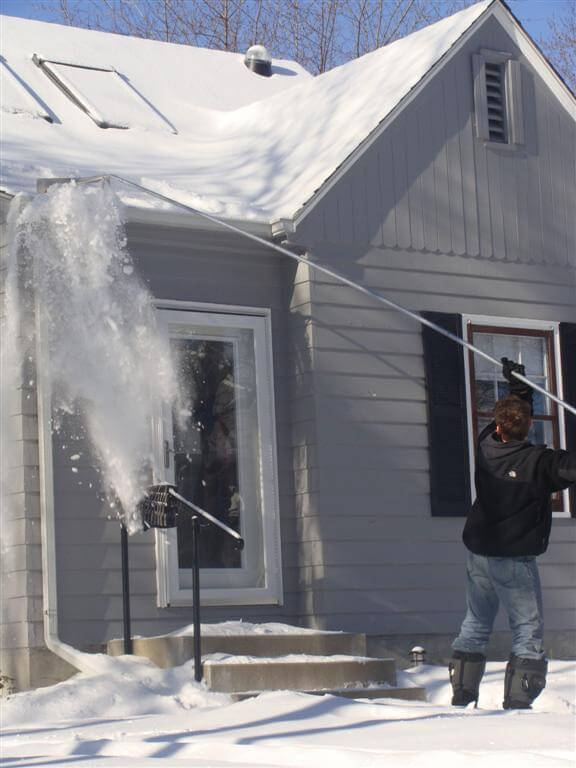
Roof RakeIf you rake the snow off your roof, you’ll keep ice dams to a minimum.  This becomes a constant chore, but it’s better than dealing with water leaking in to your house.  Just raking the first several feet of snow from the eaves is usually enough to prevent the formation of ice dams, but in some cases, this will cause ice dams to form higher up on the roof.

I have one very low-sloped section of roof at my own house where even closed-cell foam wasn’t enough to prevent the formation of ice dams, so I get out there with a roof rake and pull the snow off my roof.  This is a perfectly safe way of removing snow, as long as you don’t get too close to your overhead power lines.

This is also a very effective way of preventing ice dams, but it won’t work 100% of the time.  This year,  for the first time ever, I actually had another ice dam begin to form higher up on my roof just past where I had stopped raking.  That was crazy.  I ended up removing almost all the snow on my roof with a super-long roof rake, and that worked very well.

For owners with two-story homes where using a roof rake from the ground isn’t practical or possible, the options are to risk your life getting up on an icy roof to shovel the snow off, hire someone else to risk their life, or install roof de-icing cables as a preventative measure.  I say go with the de-icing cables.

Men Shoveling On Roof

De-Icing Cables

Roof De-Icing Cables Promotional PhotoRoof de-icing cables, also known as heat cables or heat tape, should be a last resort when it comes to preventing leakage from ice dams.  De-icing cables themselves aren’t cheap, it’ll cost money to have them professionally installed, and they’ll cost money to operate – between five and eight watts per foot.  On the flip side, they’re very effective; it’s pretty much a guarantee against leakage from ice dams.  They won’t prevent ice dams, but they’ll keep enough ice melted to create drainage channels for water, if installed properly.

If you choose to install roof de-icing cables yourself, here are a few tips:

  • Measure the areas where you need to install your de-icing cables first, and buy appropriately sized cables.  For a simple 15′ section of roof with no overhang, a gutter, and one downspout with an extension, you will need a 60′ heating cable.
  • Roof De-Icing Cables Real Life The cables should extend 6″ up the roof past the exterior wall line, through the gutters and downspouts, and 2/3 of the way up the valleys.
  • Don’t bother removing the snow from your roof; you could damage your cables, and you could potentially create another ice dam higher up on the roof, defeating the purpose of the heating cables.
  • Don’t expect the snow and ice to melt the way it does in the promotional photo above.  The photo at right, which I took at a real house, is what this stuff is going to look like.  Don’t worry, this is normal.

If fixing the causes of your ice dams isn’t a possibility and you can’t safely remove snow from your roof, install some de-icing cables or de-icing panels.  This is oftentimes the most cost-effective way to prevent leakage.

Reuben Saltzman, Structure Tech Home Inspections - EmailMinneapolis Home Inspections

Facebook Reuben's LinkedIn Page Follow StructureTech on Twitter ASHI Certified Home Inspector - Click To Verify Click to subscibe to Reuben's Blog

How To Prevent Ice Dams

December 28th, 2010 | 9 comments

We’ve received over 34″ of snow in Minnesota in the last 25 days, which makes this the snowiest December on record.  While the snow turns our state in to a beautiful white winter wonderland, it also causes nasty ice dams that wreak havoc on homes like never before.

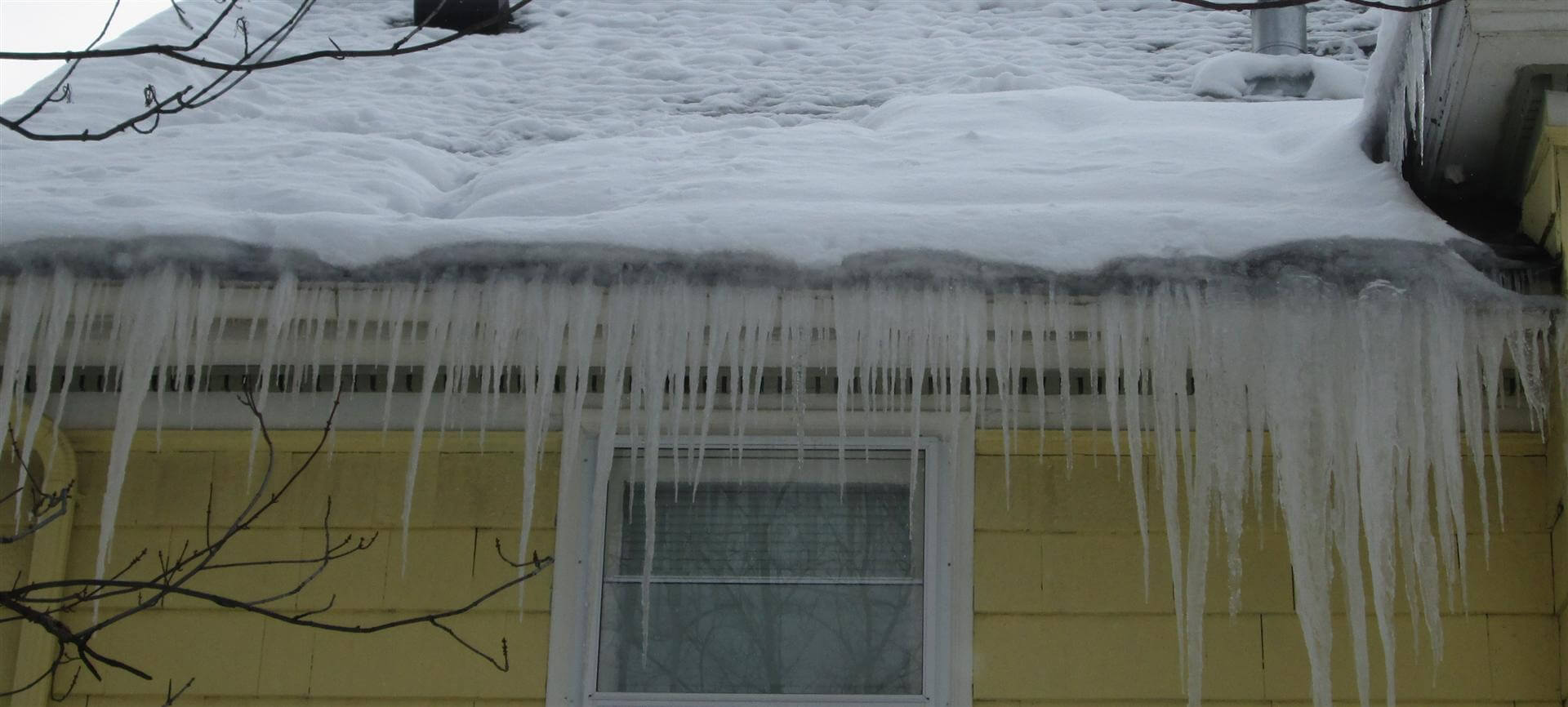
Icicles

The heavy amount of snowfall and temperatures in the teens have been the perfect conditions to create ice dams.  Water leakage from ice dams is an epidemic in Minnesota right now.  I have friends, neighbors, and family members with water leaking in to their homes.  It’s everywhere.  I’ve taken all of the photos below within the last two weeks.

Water in wall

Ice Dam

Ice on wall

Wet Insulation

Damaged Ceiling

Water at ceiling

The two things that everyone wants to know is how to get rid of ice dams and how to prevent ice dams.  As I mentioned in a previous blog, the only completely safe and effective way to get rid of ice dams is to hire a professional ice dam removal company; they’ll use steam, which will completely remove the ice dam.  Anything else is a hack method.

The best way to prevent ice dams from forming is to address the three factors in your attic that contribute to ice dams; insulation, ventilation, and attic bypasses.

Attic Bypasses (air leakage)

This is the largest contributor to ice dams.  In almost every house that I inspect to determine the cause of ice dams, I find attic bypasses directly below the beginnings of the ice dams.  Attic bypasses are passageways for warmed air to enter in to the attic space, and traditional insulation won’t fix this.  The photos below show some common attic bypasses that I can find in just about any older house.

This first photo shows one of the largest and most common bypasses – the space around the furnace and / or water heater vent.  Sometimes these are huge. The one shown below is quite small.

Bypass at furnace vent

In the photo below, you can see several holes in the top plate of a wall that were drilled for wires to pass through.  These holes could all be easily filled with spray foam, but finding these holes all over the attic would be a challenge without first removing the insulation.

Bypasses at bore holes

With additions, the transitions between the ‘new’ and ‘old’ construction seem to always be sources of attic bypasses.  I had to dig through a lot of insulation to find this gap, but I wasn’t surprised at what I found.

Bypass at addition

When plumbing vents enter in to the attic, the space around the vents needs to be sealed.  This one obviously wasn’t.

Bypass at plumbing vent

Some older houses have whole-house fans that are designed to run on hot summer nights; these fans are gigantic sources of heat loss, because they’re usually not insulated or sealed up.  I took the photo below from inside the attic without a flash on my camera.  There’s some crazy heat loss occurring there, and as you might imagine, there was a huge ice dam nearby.

Bypass at attic fan
What makes most of these attic bypasses so difficult to locate is that they’re almost always buried in insulation.  Finding these buried air leaks turns in to an educated guessing game.  Lately I’ve been using an infrared camera while doing ice dam inspections, and I’ve found it to be very useful for finding these hidden passageways.

If you plan to have more insulation added to your attic, it’s probably a worthwhile investment to have all of the existing insulation completely removed and the bypasses sealed up before you re-insulate.  There’s just no way to find all the bypasses if you don’t do this.  If your home is over 20 years old, it’s almost a guarantee that you’ll have attic bypasses that need to be sealed.  It’s a shame that so many insulation contractors just add insulation on top of what’s already there without sealing the bypasses.

I also practice what I preach; I’m such a firm believer in removing insulation and sealing bypasses before re-insulating that I did this at my own house, my parents had this done at their house, and my sister had this done at her house.  It makes a big difference.

Insulation

This is a basic concept that everyone understands; you need insulation in your attic.  If there are voids in the insulation, they need to be fixed.

My first choice would be to have about two inches of closed-cell foam insulation applied to the attic floor, and then have several inches of cellulose installed on top of that.  The closed cell foam would seal up every bypass, and the cellulose would be a cost effective way to get the insulation level up to current requirements.  The drawback with this method is cost; closed cell foam ain’t cheap.

My next choice of insulation would be all cellulose insulation, with all of the bypasses sealed first.  I prefer cellulose to loose-fill fiberglass because it has a higher insulating value per inch, it seems to do a better job of stopping air leakage, and it’s not itchy fiberglass.  I’ve been digging through a lot of fiberglass covered attics lately, and my arms start getting itchy just thinking about it.

My last choice of insulation would be loose-fill fiberglass insulation… not that there’s anything wrong with it.  I personally just don’t like dealing with fiberglass.

What about fiberglass batts?  You know, those big rolls of fiberglass?  No way, Jose.  That stuff is impossible to install properly.  Fiberglass batts leave gaps all over the place that add up to an exponential level of heat loss.  I’m pretty sure that fiberglass batts are installed in attics exclusively by handy homeowners.

Ventilation

Having adequate ventilation for the attic space will help to keep the roof surface cold, which will help to prevent snow from melting, which will help to prevent ice dams.  The best way to ventilate an attic space is with continuous soffit vents and continuous ridge vents, but this isn’t always possible.

If you don’t have enough soffit vents, add more.  If you don’t have enough roof vents, add more.  You can’t have too much ventilation.  If your soffit vents are dirty, clean ‘em or replace the grills if they’re painted shut.  Grills are cheap.  If your soffit vents are blocked with insulation, you need air chutes installed at the eaves to prevent the insulation from blocking the vents.

Reuben inspecting ice damsWhen all else fails…

If you’ve already done everything you can think of to fix your ice dams but they keep coming back, or you’ve hired a contractor to fix your ice dams but they seem to be scratching their head a lot or coming up with a bunch of different guesses, call a home inspector.  We look at this stuff every day, and some of us even specialize in ice dam inspections.

In some cases, it’s not cost effective to control ice dams from inside.  Next week I’ll be blogging about controlling ice dams from the exterior.

Reuben Saltzman, Structure Tech Home Inspections - EmailMinneapolis Home Inspections

Facebook Reuben's LinkedIn Page Follow StructureTech on Twitter ASHI Certified Home Inspector - Click To Verify Click to subscibe to Reuben's Blog

How To Prevent Ice Dams

January 17th, 2009 | 11 comments

After all the recent snowfall, it’s a good time to talk about ice dams.  Ice dams are caused by the same thing I’ve been blogging about for the last several entries; heat loss!  The most obvious sign of heat loss in attics is ice dams – those huge masses of ice that build up at the edges of roofs.  Ice dams occur because heat from the house escapes in to the attic, warms the roof, and causes snow to melt.  When the water gets to the cold overhang at the eave, it freezes.  As the ice builds up, it literally creates a dam.  The trapped water can then leak into the home and cause damage to the roof decking, structural members, insulation, and even stain the ceiling.

Ice Dam Diagram Minnesota Ice Dam Minnesota Ice Dams Big Ice Dam

To prevent ice dams from occurring, you need to stop the heat loss.  The best way to do this is to seal attic bypasses – you can read more about this in two of my recent blogs – Attic Photo Explanations and Insulation Vs. Air Leakage. The other two ways to help prevent ice dams are by having adequate insulation and ventilation.  Insulation will obviously help to prevent heat loss, and proper ventilation will help to keep the roof colder; the colder the roof, the less chance for the snow to melt in the first place.

Older one-and-a-half story houses are especially susceptible to ice dams because there is usually very little access to all of the attic spaces that need attention.  If this is the case, there are still some steps you can take to control the damage caused by ice dams.   The least expensive and most labor-intensive way to prevent ice dams is to remove the snow from the eaves using a roof rake.   It’s best to remove the snow right away, when it’s light and fluffy.  The longer you wait, the more ice will accumulate.  If you can remove the snow down to the shingles, the sun will usually keep the shingles warm enough to prevent ice from forming at the eaves.

Roof Rake

If you’re looking for a less labor-intensive method of preventing ice dams, you could install heat cables at the eaves.  These will usually prevent ice dams from forming, but electric heat cables are expensive and use a fair amount of electricity to operate, making them an environmentally UN-friendly solution.   Even manufacturers of heat cables state that they are not the most efficient way to solve ice problems.

The worst way of dealing with ice dams is to get on a ladder and hack away at your ice dams with a hatchet or ice pick.   This is dangerous, and you could cause damage to your roof.  I’ve seen many roofs with big hatchet marks in the shingles from people chopping too deep.  I don’t recommend doing this.

The bottom line?  If you can’t stop your ice dams the right way, buy a roof rake.

Reuben Saltzman, Structure Tech Home Inspections – EmailMinneapolis Home Inspections