Reuben's Home Inspection Blog

Invasive Moisture Testing on Stucco, Revisited

March 1st, 2011 | No comments

I recently wrote a blog about invasive testing vs infrared scanning on stucco homes, and concluded that invasive moisture testing is the only reliable test method for stucco homes.  I received quite a bit of feedback on ActiveRain, and even had another home inspector in San Diego, Russel Ray, write a follow-up post titled Invasive “testing”?  Are you kidding?, wherein he opines that invasive moisture testing is outdated.

Today I’m going to explain why invasive moisture testing is not outdated, as it’s the only reliable option in Minnesota, and I’m also going to discuss the differences between interior and exterior moisture testing.  But not in that order.

To gather information about this blog, I spoke with moisture testing experts from four of the larger stucco testing firms in the Twin Cities: Barry Eliason of Private Eye Home Inspections & Moisture Testing, Wayne Shellabarger of Acuity Engineers, Inc., Alan Powell of Certified Moisture Testing, and one other expert who wished to remain anonymous.  I asked them about their preferred testing methods, and asked them to explain why.  All four can provide both interior and exterior testing.

Interior vs. Exterior – The Basics

Exterior testing of stucco is done by drilling holes in the stucco at suspect locations, sticking a moisture probe in to the wall, and measuring the moisture content of the wood or wall sheathing with a special moisture testing device, such as a Delmhorst Moisture Meter.  Interior testing is done by drilling holes in the interior walls, and then sticking a long moisture probe through the wall to the exterior wall sheathing to take a moisture reading.  These are both reliable testing methods.

Interior vs. Exterior – Cosmetic Issues

Whether holes are drilled in walls from the exterior or interior, the walls won’t look exactly the same when the work is done.  I’ve inspected many stucco homes that have had invasive moisture testing done, and in every case the holes were quite inconspicuous.  The person drilling holes in stucco will come equipped with a wide range of sealants to fill the holes when they’re done, and the resulting 1/4″ holes are barely noticeable once filled with with matching caulk.  For interior testing, the holes aren’t as easy to hide or patch.  If holes are drilled in drywall, they’ll obviously need to be patched and painted over again.

Cosmetically, exterior testing is certainly preferred, as you really need to walk around the exterior of the house and carefully look for the test locations; they’re not obvious.  The photos below should help to illustrate just how inconspicuous the holes from exterior testing are.

Holes from stucco testing2

Holes from stucco testing

Holes from stucco testing3


Interior vs. Exterior – Holes In The Stucco

One concern with drilling holes in stucco is that this will compromise the drainage plane behind the wall, and the caulking used to fill the holes won’t get far enough in to the wall to seal the drainage plane again.

Wayne Shellabarger, who is opposed to exterior testing, said that he has found holes in the drainage planes that were never properly sealed up after invasive testing was performed.  I asked him if there was water damage caused by the breaks in these drainage planes; the answer was no, but he was also quick to mention that in the cases he has seen, the holes were only a year or two old.

Alan Powell said that while the holes they drill in stucco are 1/4″ holes, they don’t drill through the drainage plane behind the stucco.  The only thing that penetrates the drainage plane behind the stucco are the pin probes on the moisture testing device, which leaves 1/8″ holes.  When you think about all of the holes that get created in the drainage plane with staples and whatever else, the holes made by the pin probes will be quite insignificant.

After over a decade of invasive testing and having tested thousands of homes, none of the companies that perform exterior testing have had a single reported problem with this testing method.

Interior vs. Exterior – Accessibility

The biggest problem that Barry Eliason expressed about interior testing is that there are oftentimes interior wall surfaces that make testing impossible in some locations.  There are several places where holes can’t be drilled, such as through bath tubs, shower walls, tiled walls, and cabinets just to name a few.

Difficult locations for interior moisture testing

Difficult locations for interior moisture testing

Alan Powell also expressed concerns about being able to test in the proper places on interior walls; windows usually leak in the corners, and to properly test the right areas, the wall sheathing directly behind the walls studs is the most critical area to test.  This area can’t be accessed from the interior walls.

On the other hand, Wayne Shellabarger said that if a home has moisture problems, there will still be enough accessible areas for him to find problems, even if he can’t find every one.

Infrared, revisited

Some home inspectors say they’ve had good luck using infrared cameras to find moisture behind stucco walls, but I say they don’t know what they’re missing.  I think everyone can agree that invasive moisture testing is accurate; if a tester drills holes and sticks moisture probes in the wall, they’ll be able to locate moisture if it’s there.  To know if an infrared camera can reliably detect moisture in walls, one would need to scan a house with an infrared camera and then compare those results to an invasive moisture test.  If an infrared camera could reliably find wet areas behind stucco, it would be useful.

I have yet to hear from a single home inspector, anywhere in the country, who has performed infrared scans on houses, compared those results to an invasive moisture test performed at the same time, and can still claim that infrared scans on stucco houses are reliable.

All four testing companies that I interviewed said the same thing about infrared inspections on stucco homes: they’re unreliable.  Each company shared the exact same experience with me.  They were excited when infrared cameras came on to the market, they purchased infrared cameras, they went through extensive training on the use of IR cameras, and then they began using IR cameras on houses before performing invasive testing.  They all say that IR cameras are a completely unreliable way of finding moisture behind stucco.  Wayne Shellabarger’s web site says they use infrared cameras as a starting point before performing invasive testing, but he told me they no longer even offer that service because it has proven to be a waste of time.

Non-Invasive Moisture Meters (aka – surface scanners)

Russell Ray mentioned in his blog that he has had a 100% success rate testing for moisture on stucco homes in California using a surface scanner, such as a Tramex Moisture Encounter Plus.  This device is a fairly inexpensive non-invasive moisture detection device that, according to the manufacturer, can be used on “drywall, wood, plaster, brick, ceramic, porcelain tiles, resilient flooring, laminates, asphalt composition shingles and most building materials.”  Stucco isn’t listed.

I called the manufacturer to ask about using this device on stucco (I spoke with Penny).  She said that if the stucco has metal lath, it won’t work.  This is the same with all non-invasive surface scanners.  If the scanner is used from the interior, it also won’t work, because it won’t read nearly deep enough in to the wall to reach the exterior wall sheathing, which is the part that needs to be tested.

When Russell or anyone else has a 100% success rate using a surface scanner on stucco, that means they’re not using it on the same type of stucco that we have Minnesota.   Stucco homes in Minnesota have metal lath.  Surface scanners will have a 0% success rate on this material.  To echo Russell’s point, regional differences are huge.

Conclusion

Here in Minnesota, performing an invasive test on stucco is the only way to know what’s happening behind the stucco on a newer stucco home.  Problems can’t be positively identified using visual inspections, surface scanners, or infrared cameras.  Visual inspections will often provide clues that a problem exists, and so will infrared scans, but that’s all they can do.  Many times, stucco homes will have serious problems without any visual or infrared evidence.

As for the interior vs. exterior testing debate, they both have their pros and cons.  If you’re buying a newer stucco home in Minnesota, have an invasive moisture test performed.  You’ll need to hire a company that specializes in this, such as one of the companies that I listed at the beginning of this blog.

Oh, and of course, you’ll need to get special permission from the seller to do this.  Drilling holes in walls is invasive; home inspections aren’t.

Reuben Saltzman, Structure Tech Home Inspections - EmailInfrared Home Inspections

Facebook Reuben's LinkedIn Page Follow StructureTech on Twitter ASHI Certified Home Inspector - Click To Verify Click to subscibe to Reuben's Blog

“One Home Inspection Please, with an Infrared Scan On The Side.”

January 25th, 2011 | 3 comments

We’ve been using an infrared camera at random home inspections for the past several months, and we’ve decided that this is by far the coolest home inspection tool in the world.  It’s also pretty useful.  Today I’m going to share some of the problems we’ve been able to identify with this camera that we might not have identified without.

Roof Leaks

With all of the ice dam inspections we’ve done in the last month, we’ve looked at a ton of leaking houses.  For each photo in the series below, I made a duplicate of the original image, then overlaid the thermal image on top of the original.  It’s pretty easy to identify the wet areas in the thermal images, but they’re not apparent in the original photos.

All of the homes shown below had roof leaks from ice dams.

IR Image - water leak 1

IR Image - water leak 2

IR Image - water leak 3

IR Image - water leak 4

IR Image - water leak 5

IR Image - water leak 6

IR Image - water leak 7

IR Image - water leak 8

IR Image - water leak 9

IR Image - water leak 10

I could share more, but I’m pretty sure I’ve made my point.  Thermal imaging can be used to find roof leaks.  The one caveat to finding roof leaks is that the conditions have to be right; if it’s a hot summer day and there hasn’t been any rain for a week, forget it.

Hot Spots In Attics

Warm attics cause snow to melt, which is what causes ice dams.  I’ve found an infrared camera to be invaluable while troubleshooting the causes of ice dams.

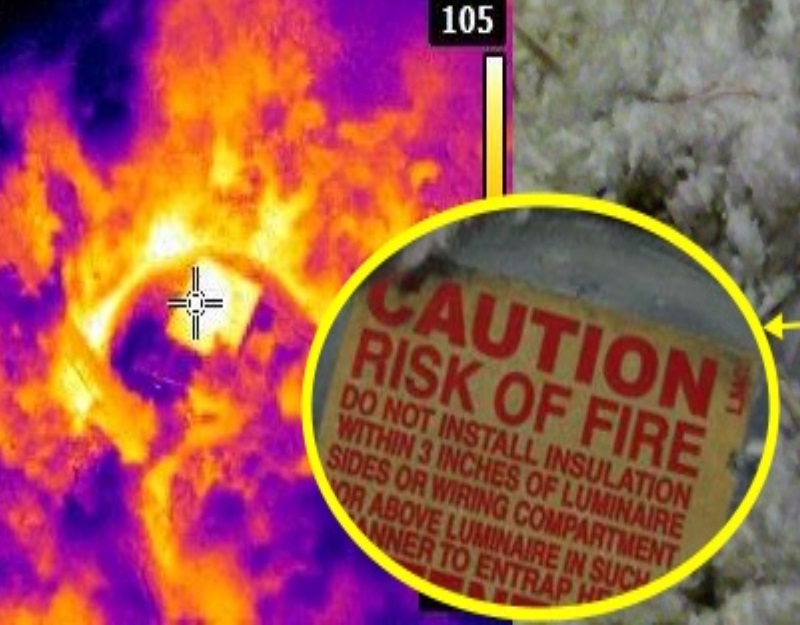
The photo below shows a warm spot in an attic that I never would have identified without an infrared camera.  The culprit was a flush-mounted light fixture with light bulbs that had too high of a wattage.  I don’t make a habit of taking apart light fixtures to check the wattage on light bulbs, but I’ll do it if something tips me off.

IR Image - warm attic

Uninsulated ductwork in an attic is also a problem; the heat loss is quite obvious with an infrared camera.  The photo below came from an attic with an insulation value of R-60.  Who would have thought it?

IR Image - uninsulated ductwork

Recessed lights are a huge contributor to warm attics, whether they’re airtight or not.

IR Image - recessed light2

Improper Insulation

This is one of the most obvious uses for an infrared camera.   The photo below shows an attic access panel that wasn’t properly insulated.

IR Image - attic panel

This next image shows an interior wall that was very cold, because there was a missing section of insulation in the attic behind this wall.

IR Image - cold wall

The photo below shows the same section of wall, as seen from inside the attic.

Attic Insulation 3

In the photo below, there is an obvious cold spot where the insulation was missed or improperly installed.

IR Image - missing insulation

Heating Systems

If a radiator doesn’t heat up properly, it will be quite obvious with an infrared camera.  The photo below shows a radiator working properly; while I’m not demonstrating a problem here, I just thought this was a cool image to include :)

IR Image - radiator

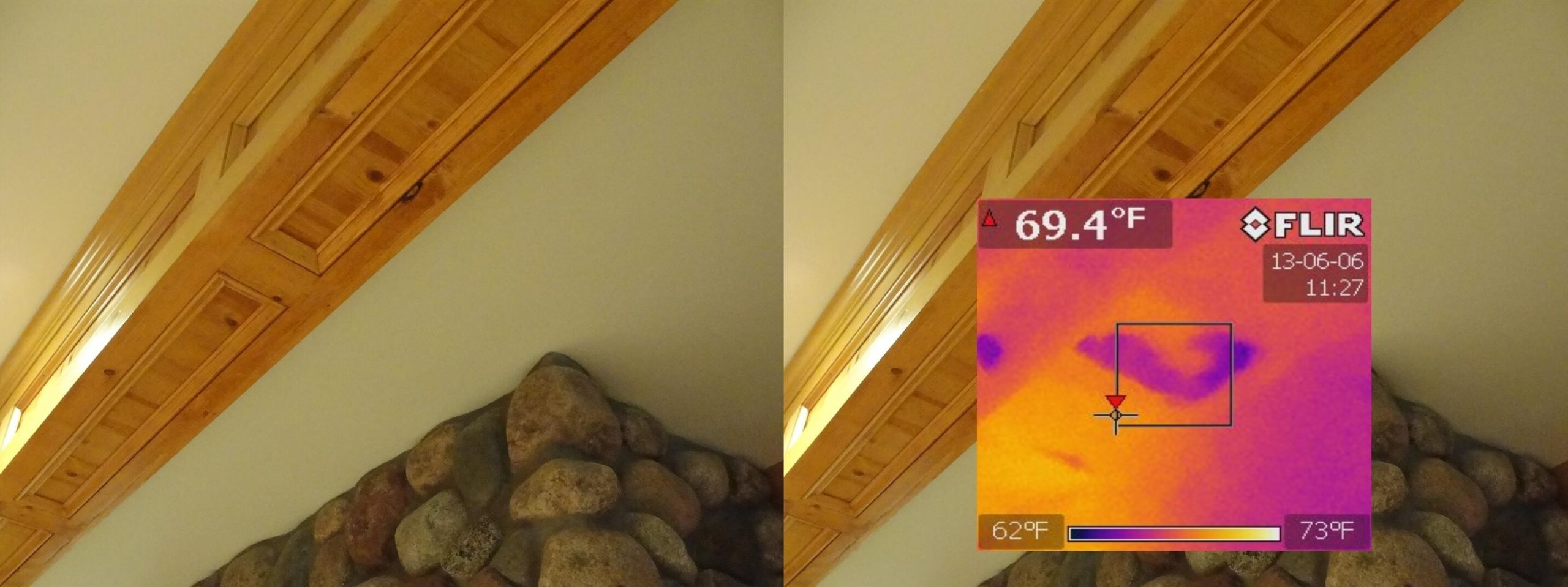
If there are voids or leaks in heating tubes for in-floor, in-wall, or in-ceiling heat, an infrared camera will probably find them.  The photo below shows an inconsequential gap in the tubing at this heated ceiling.

IR Image - ceiling heat

I’m sure I’ll have plenty more interesting photos to share as the months go on, but these photos should help to answer the question everyone asks: “Why would I want an infrared scan with my home inspection?”

For the record, one thing we don’t offer and never will offer is infrared scans on stucco homes in lieu of invasive testing.  I’ll have more on that topic another day.

Reuben Saltzman, Structure Tech Home Inspections - EmailMaple Grove Home Inspections

Facebook Reuben's LinkedIn Page Follow StructureTech on Twitter ASHI Certified Home Inspector - Click To Verify Click to subscibe to Reuben's Blog