Reuben's Home Inspection Blog

Mold in the Attic

March 20th, 2012 | 1 comment

If you see black stuff covering or growing on the roof sheathing in your attic, it’s probably mold.  It’s never fun to find out that your house has mold, but the fix for mold in the attic is usually quite straightforward, and doesn’t involve the services of any ‘mold remediation experts’.

There are a lot of folks in the real estate industry, including home inspectors, who get very excited when the word ‘mold’ comes up.  I actually sat through a seminar where we were told to never even use the word mold, because “you never know what something is without testing it.”  I couldn’t help pointing out that by that logic, we should no longer call houses ‘wood framed’ houses unless we test the material to verify that it’s actually wood.

Mold in attic

What causes mold in an attic

When mold grows in an attic, it’s caused by a moisture problem.  Period.  Some moisture sources are obvious and have a huge impact – bathroom exhaust fans, kitchen exhaust fans, clothes dryers… they all pump moisture out of the house, and they should never be vented in to the attic.   Everyone knows that, right?

Bath fans venting in to attic

The less obvious moisture sources are attic bypasses; air leaks that allow relatively warm, moist air from the house to get in to the attic.  To reduce the amount of moisture getting in to an attic, the attic air leaks need to be sealed off.  Covering these air leaks with traditional insulation doesn’t stop the air movement; there needs to be some type of air barrier installed, such as foam insulation or caulk.  These attic bypasses show up quite clearly with an infrared camera, but any well-trained insulation contractor will already know exactly where to look for these.

Photos of Attic Bypasses / Attic Air Leaks

I’ve accumulated about a bazilli0n photos of attic bypasses over the years, so included below are a few of the most common places you’ll find attic bypasses in just about every Minnesota house built before 1991.  In all of the photos below, I’ve pulled the insulation away to reveal the bypasses; you won’t find any of these in your attic without moving insulation around.  For the record, home inspection standards of practice don’t require the home inspector to move insulation… so don’t be surprised if your home inspector didn’t mention any of this stuff.

Any time small cables or wires pass through the top plates of walls in to the attic, the holes for the wires should be sealed up.  When they’re not sealed, they leak air.  Do you see how some of the insulation in the photo below has been darkened?  It’s not mold.  This is the result of years and years of air leaking through the insulation; the insulation acts like a filter, and traps all the dust in the air, turning it black.  Even though these tiny holes don’t seem like a big deal, having them all over your attic can have a huge effect.  Sealing these gaps can be easily accomplished with a can of foam insulation.

attic bypasses around wires

Larger penetrations in to the attic, such as plumbing vents, also need to be sealed.  Again, foam in a can works well.

attic bypass around plumbing vent

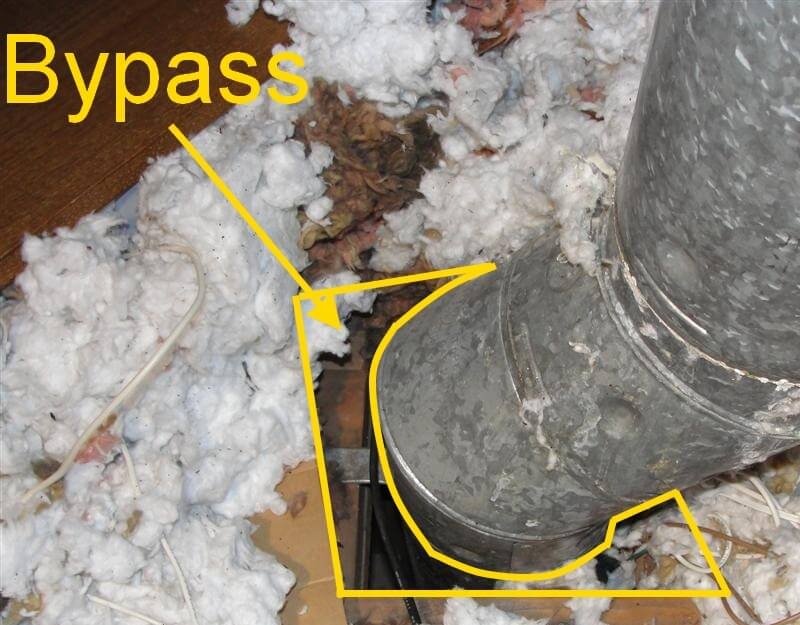
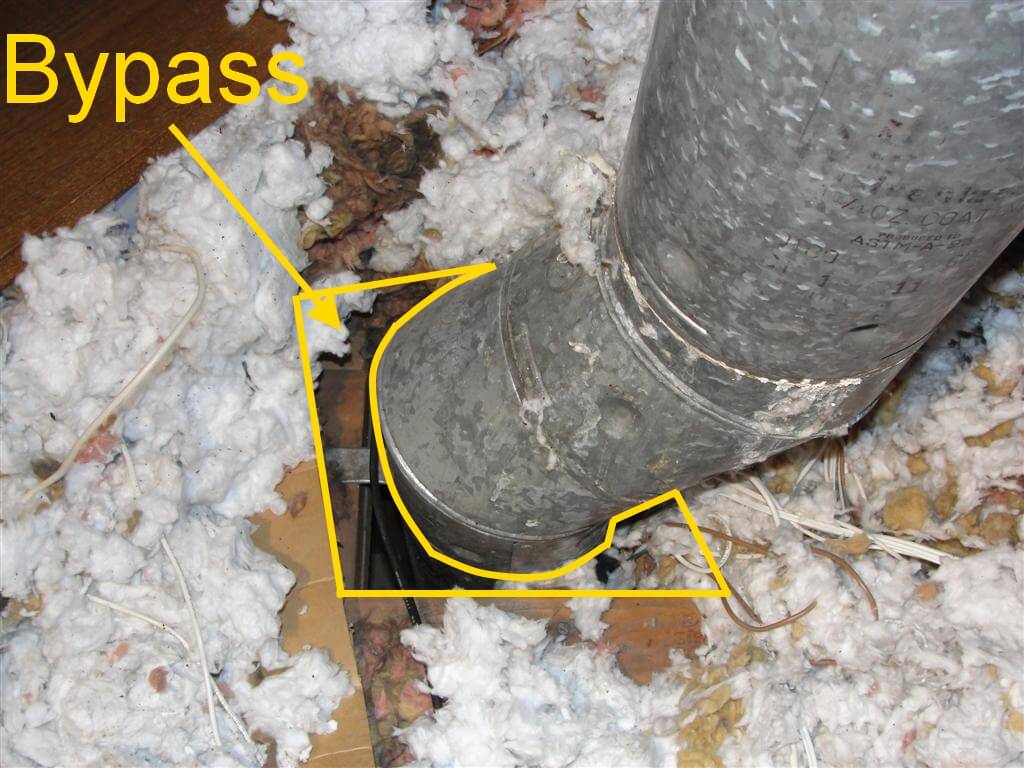
The first place I always check for attic air leaks is around the furnace vent; if there is air leaking in to the attic around this chaseway, there will surely be air leaking everywhere else.  In this first photo, the darkened insulation is a dead giveaway that there is a lot of air leaking through here.  Foam insulation wouldn’t be an appropriate repair for this location – the vent is supposed to have at least one inch of clearance to anything combustible.  In the photo below, installing a small block of wood to fill the gap at the bottom (maintaining a one inch clearance to the vent) and then sealing the entire assembly with high-temperature caulk would be a good fix.

Attic bypass around furnace vent with fire stop

Here’s another furnace vent – this one is completely missing the sheet-metal collar.  I could see right down in to the walls after pulling the insulation away.  This is very common.

Attic bypass around furnace vent

Here’s a huge bypass around a furnace vent; the chaseway that leads down to the basement was large enough for a person to fit through, and it was basically wide open at the attic; they just had a piece of fiberglass insulation covering the top.  You can clearly see the basement ceiling from inside the attic.

Huge Attic bypass around furnace vent

The space around masonry chimneys will often be a source of air leakage.  If the chimney is being used for a wood burning fireplace, there needs to be a two-inch gap to combustible materials.  Sealing these air leaks will require the use of high temperature caulk and sheet metal.

attic bypass around chimney

As I mentioned in my blog about evil recessed lights, they can be a huge source of attic air leakage.  Notice all the light pouring through this fixture; the light equates to a lot of air leakage.

attic bypass around recessed light

When additions are put on, the transitions between the new and old portions of the house are often sources of air leakage.

attic bypass at addition

Whole-house attic fans can be a major source of air leakage in to attics.  These are fans that are designed to be run in the summer only.  The photo below shows light leaking through the attic fan, which means a lot of air is leaking through as well.

Attic bypass around whole-house fan

Probably the largest attic bypass that I commonly find is the one above the stairway to the basement on old ramblers.  All of the wall cavities are wide open to this space, and nothing above it is sealed off.  This is a bypass that’s large enough to fit a small family in to.  Other areas where ceilings drop down in older houses will be areas to look for bypasses – especially over bath tubs and kitchen soffits.

attic bypass over stairway

Finally, the space below the knee walls in old one-and-one-half story houses can be a major source of air leakage.  The way to repair this is to have solid blocking installed underneath every joist cavity, and have it made completely airtight.

attic bypass in knee wall

This is certainly not an all-inclusive list of the places to find attic air leaks, but it should be enough to help you understand what an attic bypass is.  This is how air leaks in to the attic.  When all of these air leaks are perfectly sealed and a vapor barrier is properly installed in the attic, the attic interior will stay dry.

What if the air leaks can’t all be sealed?  Sealing off all of the attic air leaks is nearly impossible to do without completely removing all of the existing insulation. I’ve actually recommended doing this many times, but before starting with such a drastic measure, it’s a good idea to check the obvious stuff in the house first.  If the house is too humid, fix it.  A large percentage of attic moisture problems are caused by whole house humidifiers.  This fix for this situation is a no-brainer; turn the humidifier off.

Does adding more ventilation fix the problem?  Attic ventilation is required by the building code, but it’s not a magic elixir.  Air moving through an attic will help to remove moisture, but this isn’t the cure for a moldy attic.  I’ve heard many people conclude that an attic mold or moisture problem was caused by lack of ventilation, but that’s a little like saying a hangover was caused by not taking enough Advil before going to bed.  Adding more ventilation to an attic is just a way of dealing with the symptoms, and it doesn’t always work.

So what needs to be done about the existing mold?  It depends on who you ask.  If you talk to someone who has a financial interest in cleaning up the mold, they’ll tell you it needs remediation.  If you ask someone who could get sued for not recommending professional remediation, odds are they’ll tell you to have professional remediation.  Other people might argue that once the air leaks between the house and attic have been sealed off, it won’t matter what’s in the attic.  As long as the roof sheathing isn’t rotted, I tend to agree.

For the record, sealing off attic bypasses is also one of the most effective ways of preventing ice dams and preventing frost accumulation in the attic.  The Minnesota Department of Commerce has an excellent guide to finding and repairing attic bypasses, which gives more detailed information on how to find all of these bypasses and how to fix them.

Reuben Saltzman, Structure Tech Home Inspections - Email - Minnesota Home Inspector


Thinking of adding more insulation to your attic? Read this first.

February 15th, 2011 | 7 comments

If you’re tired of dealing with ice dams and you’ve decided to finally get your attic re-insulated, please read this first.  You might save yourself a lot of time and money.

Over the past two months, a large portion of my business has been ice dam inspections in Minnesota.   For most of these inspections, I was hired to determine the cause of the ice dams and to recommend a solution.

I feel extremely fortunate to have spent the past two months doing this.  During this time, I’ve dug through a ridiculous amount of insulation in attics.   I’ve come home with itching arms, neck, cheeks, and red eyes (I’m pretty sure fiberglass insulation was invented by a very evil person).  Most importantly, I’ve learned quite a bit about attics.

I’d like to share the complaints I’ve heard from homeowners, what I’ve learned, and what I’ve recommended.  My goal is to help homeowners benefit from my experience.

What I’ve Heard

I had more insulation added to my attic after last winter, but the ice dams are just as bad as they were last year, if not worse!

I heard versions of this statement over and over from frustrated homeowners.  Just adding more insulation typically won’t fix ice dam problems.  I’ll come back to this.

I just had a new roof installed, and the roofer said they laid down a rubber membrane going six feet up.  Obviously my roofer is a liar, because if they really had laid down a rubber membrane like they said, my roof wouldn’t be leaking.

I’ve heard so many versions of this!  The ‘rubber membrane’ that everyone refers to is actually an underlayment that’s commonly referred to as an ice and water shield.  This underlayment is required by the Minnesota State Building Code; it must be installed underneath the shingles and “extend from the eave’s edge to a point at least 24 inches inside the exterior wall line of the building.”  This stuff comes in a three foot roll, and roofers usually have to lay down two layers of it to get 24″ inside the exterior wall line, so it’s usually six feet.

Ice and water shield will not prevent roof leakage from ice dams. Ice dams can cause leaks above the underlayment, or even right through the underlayment; I’ve seen it happen.  According to Certainteed, the manufacturer of Winterguard underlayment, it “provides your first line of defense.”  It’s not a guarantee against leaks.

If you have ice dams and your roof leaks during the winter, don’t blame your roofer.  I can almost guarantee you that it has nothing to do with the way your roof was installed.

Why do I live in Minnesota?

This last weekend was a great reminder of why we live in Minnesota.  The temperature shoots up to 40 degrees and it feels like summer is around the corner.

What I’ve Learned

Gutters don’t cause ice dams. Ok, I always knew this, but I’ve noticed plenty of ice dams with no gutters this year.  Ice dams will show up whether gutters are installed or not.  I mention this because I actually heard a ‘professional’ guest on a local radio show say that gutters cause ice dams, and that homes without gutters won’t get ice dams.  I’m sorry, but that just ain’t true.  You should have seen me ‘calmly’ disagreeing with my radio when I heard this.

Ice dam with no gutters 3

Ventilation has little to do with ice dams. I’m sure I’ll get plenty of indignant feedback for this blasphemous statement.  I’ve always been taught that you won’t get ice dams if you have enough ventilation, and I even used to preach this myself.  This is a concept that is deeply ingrained in the minds of contractors, roofers, and home inspectors everywhere.

Nevertheless, from all of the houses I’ve been to, I’ve seen little to no relationship between attic ventilation and ice dams.  Sure, attic ventilation is required.  Attic ventilation will help to cool the attic space, which helps to cool the roof decking, which helps to prevent snow melt, which helps to prevent ice dams… but this is a very small part of the equation.

The Minnesota Department of Commerce lists attic ventilation as a non-solution to ice dams.  TheUniversity of Minnesota Extension says that “only small amounts of roof ventilation are needed to maintain uniform roof surface temperatures.”

Adding more ventilation probably won’t change your ice dam problems.  Shoveling the snow off your roof vents probably won’t change your ice dam problems.

Adding more insulation to your attic probably won’t fix your ice dam problems. As I mentioned at the beginning of this blog, I’ve been to a ridiculous number of houses this winter where insulation was added, but the problems didn’t go away.

If an attic lacks insulation, it’s probably an older attic.  Not always, but usually.  If it’s an older attic, it’s pretty much a guarantee that there are attic bypasses present.  Attic bypasses are passageways for warm air to get in to the attic, and they’re the driving force behind ice dams.  In almost every home that I inspected this winter, attic bypasses were at the root of the ice dams, regardless of how much insulation was present.  Through the use of an infrared camera, I’ve learned that insulation can’t make up for air leakage.

It doesn’t matter how much insulation is present in an attic; if there are air leaks, warm air will pass through traditional insulation.  The images below help to illustrate this; this was a very small attic bypass, but it still shows up plain as day through 14″ of loose fill fiberglass and another 4″ of cellulose on top of that.  I have hundreds of image sequences just like this.

Attic bypass

Recessed lights are huge contributors to ice dams. I recently wrote about this in another blog - Recessed Lights Are Evil.

What I’ve Recommended

I’ve recommended the same thing over and over; seal the attic bypasses.  They’re the main cause of the ice dams.  When insulation has already been added to an attic space, this becomes an extremely difficult, if not impossible chore.  To access and seal the attic bypasses, you first need to know where they are.  When they’re buried under one to two feet of insulation… forget it.

An experienced insulation contractor might be good enough at their job to know where to look for most of the attic bypasses, and could spend their time digging through the insulation to find most of them, but without completely removing the existing insulation, there is no way to seal all of them.

In most cases, I’ve told homeowners that they can hire an experienced insulation contractor to seal up all of the attic bypasses that they can find, and to keep their fingers crossed.  This will probably be enough to prevent leakage from ice dams again, and it will be a good repair, but not complete.  For a complete repair, all of the existing insulation needs to be removed so all of the attic bypasses can be located and sealed.

If you’re going to have insulation added to your attic, be sure to seal the attic bypasses first.

Reuben Saltzman, Structure Tech Home Inspections - EmailMaple Grove Home Inspections

Facebook Reuben's LinkedIn Page Follow StructureTech on Twitter ASHI Certified Home Inspector - Click To Verify Click to subscibe to Reuben's Blog

Attic Problems On A New Construction Home

March 3rd, 2009 | 8 comments

We recently inspected a new construction, custom built home in Edina.  We did a team inspection at this property, where Neil, Duane, and I all inspected the house at the same time.  We really went over this house with a fine tooth comb, but we didn’t come up with much that was wrong – it was a very well built home.  Towards the end of the inspection, we asked the buyer if they would mind us opening up the attic access panel, which had been sprayed shut.  The buyer was fine with that, as most buyers are.  What we found was quite surprising.

Frost in Attic The builder had taken all of the necessary steps to seal all of the bypasses to the attic,  by doing something most builders never do.  Before blowing in loose-fill fiberglass insulation, he had a company spray foam the ‘lid’ to really make sure that any potential bypasses to the attic would be completely sealed.  This isn’t required, but it’s a great idea.  Unfortunately, the person doing the insulation had missed a few areas, and this allowed a ton of frost in to the attic!

The builder was very glad we found this, and quickly had the insulation company back out to re-insulate the areas that were missed.  This is a great example of why it’s so important to break the attic access seal, and why it’s so important to have even new construction homes inspected, no matter how good the builder is.

The best builders will encourage their buyers to have private home inspections performed, and they’ll welcome any feedback from home inspectors.  This will not only prove to the buyer what a good house they’re buying, but can also save the builder from major potential problems in the future.

Reuben Saltzman, Structure Tech Home Inspections – EmailEdina Home Inspections

RELATED POSTS

Frost in Attics

February 17th, 2009 | 5 comments

This Minnesota winter has been an especially problematic one for frost in attics, and it seems that most people don’t understand why it happens or how to fix it.  There is a lot of mis-information floating around about why frost gets in to the attic and how to fix it, but I’m going to give you the real story.

This winter we experienced an unusually long cold spell in Minnesota, with temperatures never climbing above freezing for about a month.  This means cold attics.  When moist household air is allowed to escape from the house to the attic, it condenses on the roof boards in the form of frost.  When this happens for a long period of time, a lot of frost can accumulate.  When the frost melts, it soaks the insulation in the attic, stains the ceiling, and can even leak out through windows (I talked to someone last week who was having this problem).

I’ve heard several homeowners tell me they called their roofer out because they thought the stains on their ceiling were caused by a leaking roof, and of course it wasn’t a roof problem.  Nevertheless, the roofers typically suggest adding more ventilation to the attic space.  This will not fix the problem.  To suggest adding more ventilation to a roof to fix frost in the attic is like telling someone with a leaking water pipe to install a dehumidifier.  Ventilation is not the way to fix frost in the attic.

The fix for frost in the attic is sealing attic bypasses – these are passageways from the conditioned household space to the attic.  Bypasses are what allow moisture in the attic to begin with, and this is what needs repair.  While bypasses are certainly the most common cause of frost, there are other ways it can happen, and these are much more obvious.  Disconnected bath fans can be particularly problematic, and disconnected furnace flues can be catastrophic.  The photo below is one of my favorites – when the roof was replaced, the furnace flue came loose in the attic, which quickly turned the attic in to a winter wonderland.

Ice in Attic

If you’ve had frost in your attic, wet insulation in your attic, or stains on your ceiling, find your attic bypasses and seal them.  If you’re not sure how, read my related posts or give me call.

Reuben Saltzman, Structure Tech Home Inspections – EmailMinneapolis Home Inspections

How To Prevent Ice Dams

January 17th, 2009 | 11 comments

After all the recent snowfall, it’s a good time to talk about ice dams.  Ice dams are caused by the same thing I’ve been blogging about for the last several entries; heat loss!  The most obvious sign of heat loss in attics is ice dams – those huge masses of ice that build up at the edges of roofs.  Ice dams occur because heat from the house escapes in to the attic, warms the roof, and causes snow to melt.  When the water gets to the cold overhang at the eave, it freezes.  As the ice builds up, it literally creates a dam.  The trapped water can then leak into the home and cause damage to the roof decking, structural members, insulation, and even stain the ceiling.

Ice Dam Diagram Minnesota Ice Dam Minnesota Ice Dams Big Ice Dam

To prevent ice dams from occurring, you need to stop the heat loss.  The best way to do this is to seal attic bypasses – you can read more about this in two of my recent blogs – Attic Photo Explanations and Insulation Vs. Air Leakage. The other two ways to help prevent ice dams are by having adequate insulation and ventilation.  Insulation will obviously help to prevent heat loss, and proper ventilation will help to keep the roof colder; the colder the roof, the less chance for the snow to melt in the first place.

Older one-and-a-half story houses are especially susceptible to ice dams because there is usually very little access to all of the attic spaces that need attention.  If this is the case, there are still some steps you can take to control the damage caused by ice dams.   The least expensive and most labor-intensive way to prevent ice dams is to remove the snow from the eaves using a roof rake.   It’s best to remove the snow right away, when it’s light and fluffy.  The longer you wait, the more ice will accumulate.  If you can remove the snow down to the shingles, the sun will usually keep the shingles warm enough to prevent ice from forming at the eaves.

Roof Rake

If you’re looking for a less labor-intensive method of preventing ice dams, you could install heat cables at the eaves.  These will usually prevent ice dams from forming, but electric heat cables are expensive and use a fair amount of electricity to operate, making them an environmentally UN-friendly solution.   Even manufacturers of heat cables state that they are not the most efficient way to solve ice problems.

The worst way of dealing with ice dams is to get on a ladder and hack away at your ice dams with a hatchet or ice pick.   This is dangerous, and you could cause damage to your roof.  I’ve seen many roofs with big hatchet marks in the shingles from people chopping too deep.  I don’t recommend doing this.

The bottom line?  If you can’t stop your ice dams the right way, buy a roof rake.

Reuben Saltzman, Structure Tech Home Inspections – EmailMinneapolis Home Inspections